

What is pancreatic cancer?
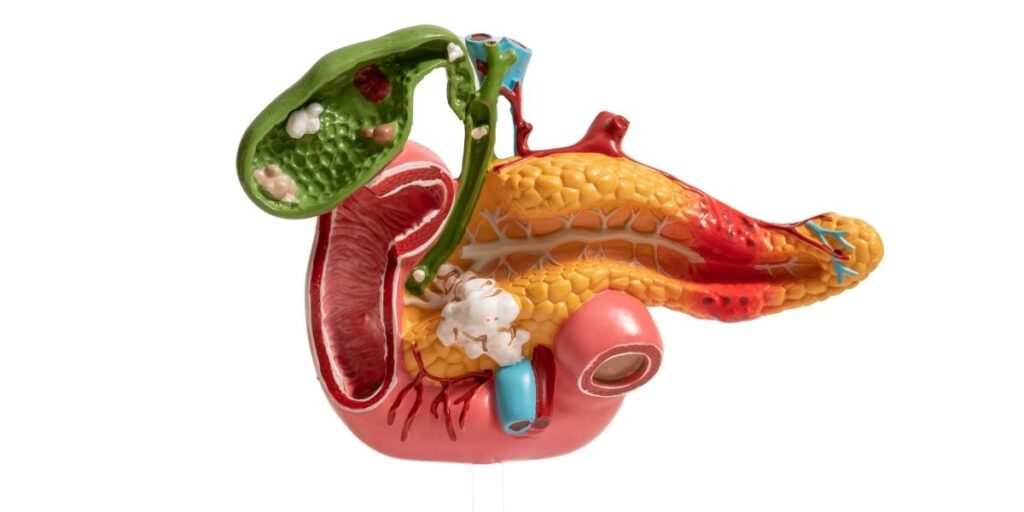
The pancreas has both “endocrine and exocrine” functions and is the second-largest gland of the digestive system after the liver. In its endocrine role, the pancreas produces hormones such as insulin and glucagon. Its exocrine function is essential for digestion. The enzymes needed for the digestion of sugars, fats, and proteins are produced in the pancreas. It is also a vital organ for keeping blood sugar levels in balance.
Pancreatic cancer refers to malignant (cancerous) tumors that develop in the pancreas.
What are the symptoms of pancreatic cancer?
Pancreatic cancer usually does not cause symptoms, because the pancreas is located deep in the body, surrounded by many organs. For this reason, it cannot be detected through physical examination or standard check-up tests. Symptoms typically appear in advanced stages of the disease, which is why it is considered a silent and insidious type of cancer.
Its symptoms are as follows:
- Persistent back and abdominal pain
- Weight loss
- Jaundice
- Loss of appetite
- Fever
- Difficulty digesting
- Pale or yellowish stools
- Depression
- Sudden-onset diabetes
- Darkening of the urine
- Fatty (greasy) stools
What is pancreatic cancer?
The exact causes of pancreatic cancer are not fully known. However, mutations occurring in the pancreatic ducts or in the “acinar” cells—also known as the pancreas’s own glandular cells—are associated with the development of pancreatic cancer. Although there are studies supporting these theories, a definitive cause that directly leads to pancreatic cancer has not yet been identified.
What are the symptoms of pancreatic cancer?
Pancreatic cancer is classified into two types—metastatic and non-metastatic—and four stages. Each type requires different treatment approaches.
How is pancreatic cancer staged?
Pancreatic cancer is staged differently from many other cancer types. Normally, cancers are staged based on the size of the tumor.However, in pancreatic cancer, even a very small tumor may already have invaded blood vessels or metastasized to other organs. For this reason, even a small tumor can be classified as stage 4 disease.
In stage 1 of the disease, tumors are brought to a condition where they can be removed surgically. Depending on the spread of the disease to surrounding organs and vessels beyond the pancreas, it is classified as stage 2 or 3. In these stages, tumors are reduced with personalized chemotherapy treatment plans, and surgical intervention is also performed.
If the cancer has spread to organs beyond the pancreas, it is considered to be in stage 4. In this case, surgical treatment is no longer an option, and chemotherapy becomes the primary treatment. A personalized chemotherapy plan is created for these patients.
What is the incidence of pancreatic cancer?
The incidence of pancreatic cancer is approximately one in ten thousand. Although it is not among the 10 most common cancers, pancreatic cancer ranks among the leading cancers that cause death. Its incidence continues to increase every year, which is why it is considered one of the most dangerous cancer types.
In which individuals and age groups is pancreatic cancer most commonly seen? Does its frequency differ between men and women?
Pancreatic cancer occurs more frequently between the ages of 60 and 65. There is no difference in incidence between men and women; however, genetic predisposition may cause pancreatic cancer to appear in younger patients between the ages of 30 and 45.
People with a family history of pancreatic cancer at a young age fall into the risk group. Therefore, it is important for them to be monitored through special screening programs.
What are the screening and diagnostic methods for pancreatic cancer? What should individuals with a genetic predisposition pay attention to?
Today, there are well-established screening methods for the early diagnosis and treatment of colon, breast, and prostate cancers; however, unfortunately, there is no specific screening or testing method for pancreatic cancer. For this reason, patients should pay attention to symptoms such as abdominal pain and back pain that last longer than a week and undergo appropriate diagnostic evaluations. Ultrasound alone is not sufficient in imaging. Therefore, imaging techniques such as CT (computed tomography) and MRI (magnetic resonance imaging) are preferred.
Additionally, elevated levels of the tumor markers known as CA19-9 and CEA in the patient’s blood tests are also findings that need to be monitored.
How does pancreatic cancer begin and progress?
Pancreatic cancer begins in the pancreas and spreads very rapidly. This type of cancer does not spread only through the bloodstream; it spreads to the nerves inside and around the pancreas and from there quickly involves the surrounding vessels. For this reason, the disease is often not detected in its early stages. Cancer cells that spread to the nerves around the pancreatic vessels enter the lymphatic pathways and blood vessels, allowing the disease to progress to other organs. In the first stage, it most commonly metastasizes to the liver, and in the second stage, usually to the lungs. Pancreatic cancer rarely spreads to the brain or bones.
What is the survival rate for patients with pancreatic cancer?
The five-year survival rates of cancer patients are generally evaluated using a five-year parameter. About 25 years ago, the five-year survival rate in pancreatic cancer was around 15–20%. Today, with radical surgery and neoadjuvant chemotherapy agents administered before and after surgery, the survival rate has reached 51%.
How is pancreatic cancer treated?
Pancreatic cancer treatment is planned with a multidisciplinary approach, bringing together specialists from different medical fields. In cases where the disease has spread to the blood vessels, neoadjuvant therapy is applied (chemotherapy, radiation therapy, or hormone therapy administered initially to shrink the tumor before surgical treatment).
When there is arterial involvement, radiation therapy is added to the treatment plan alongside medical oncology to shrink the tumor, after which the patient undergoes surgery. After the tumor is surgically removed, chemotherapy is continued to prevent recurrence and improve survival.
How is the surgical method determined in the treatment of pancreatic cancer?
The surgical method is determined according to the location and stage of the tumor within the pancreas. In most cases, the tumor is located in the head of the pancreas, and in such situations, the Whipple procedure is required.
What is the Whipple procedure, and what is its role and importance in the treatment of pancreatic cancer?
The Whipple procedure, first performed by Professor Allen Whipple and named after him, is used particularly for cancers of the pancreatic head, the duodenum, and the bile duct. Since all of these structures are located in the same region, the same surgical technique is applied.
In this surgery, the head of the pancreas and the duodenum are removed together, which means that three essential pathways required for digestion are eliminated. At this point, when the duodenum and the pancreatic head are removed in the Whipple procedure, three new pathways must be reconstructed for digestion. During the operation, the small intestine is brought up to the area where the duodenum was cut. New connections are then created between the intestinal system and the pancreas, the bile duct, and the stomach, allowing the patient to return to a functional digestive system.
What surgical methods can be used in the treatment of pancreatic cancer?
In pancreatic cancer surgery, laparoscopic, robotic, or open surgical techniques can be used. The choice of method is determined by the surgeon based on the location and stage of the cancer.
How can a person live without the pancreas after a Whipple surgery?
When the pancreas is completely removed, its two main functions must be supported from the outside. The first of these functions is the production of insulin, the hormone that regulates blood sugar levels. When the pancreas is entirely removed, patients must receive insulin externally.
Its second function is producing enzymes required for digestion. After the surgery, patients overcome the lack of digestive enzymes by taking enzyme tablets with meals.
What is the recovery process like after a Whipple surgery?
In this surgery, the head of the pancreas and the duodenum are removed together, which means that three essential pathways for digestion are eliminated. For this reason, when the duodenum and the pancreatic head are removed during the Whipple procedure, three new pathways must be reconstructed for digestion. During the operation, the small intestine is brought up to the area where the duodenum was cut. New connections are then created between the intestinal system and the pancreas, the bile duct, and the stomach, allowing the patient to regain a functional digestive system.
What is the neoadjuvant treatment process applied to shrink the tumor?
The treatment process in pancreatic cancer is a team effort, and the patient is a very important part of this team. The multidisciplinary treatment approach is explained to the patient in detail. For patients whose tumors cannot be surgically removed at the initial stage due to the tumor’s location and stage, neoadjuvant therapy is applied thanks to recent medical advancements. With this treatment, the tumor is first reduced in size and then made suitable for surgical removal.
In neoadjuvant treatment, patients first receive chemotherapy. In cases where there is significant vascular involvement, radiation therapy is also added to the treatment plan. In cases where only chemotherapy is administered, patients generally become eligible for surgery after 2.5 to 3 months of treatment; however, when radiation therapy is given alongside chemotherapy, the process may take a bit longer.