

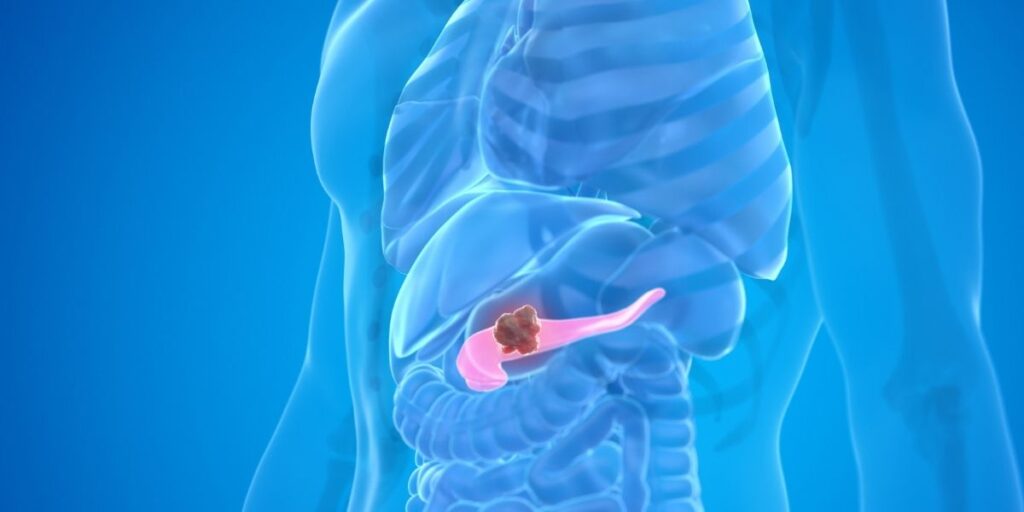
For the diagnosis of pancreatic tumors, imaging methods such as CT, MRI, MRCP (showing the bile and pancreatic ducts), and endoscopic ultrasound are used.
In the endoscopic ultrasound (endosonography) method, a sonography device is used alongside the endoscope as it enters the stomach. Since the pancreas is located above the stomach, tumors in the pancreas can be clearly distinguished using this method. Therefore, endosonography stands out as the most definitive method for detecting a tumor.
Is every tumor in the pancreas cancerous?
Not every tumor in the pancreas is pancreatic cancer. There are two different types of tumors: fluid-filled cystic tumors and solid tumors. Cystic tumors are further divided into subgroups. While some cystic tumors are completely harmless, certain types carry a 25–45% risk of becoming cancerous.
What is a pancreatic cystic tumor?
A pancreatic cystic tumor is a fluid-filled tumor. This fluid can be either serous or mucinous. Serous fluid appears mostly like water and is clear, while mucinous fluid is sticky and viscous.
What are the symptoms of pancreatic cystic tumors?
Symptoms vary depending on the tumor’s location in the pancreas. Tumors in the outer parts of the pancreas usually do not cause symptoms, but pain may occur if they press on a blood vessel. In some cases, what is thought to be pancreatitis may actually be caused by a pancreatic tumor. Therefore, symptoms need to be carefully evaluated.
Pancreatic Cystic Tumors
Pancreatic cysts are classified into four main groups. The treatment process is planned according to the type of cyst.
i. İntraduktal papiller müsinöz neoplazi:
IPMN (Intraductal Papillary Mucinous Neoplasms) are mucin-producing tumors that arise from the pancreatic duct. IPMNs occur in the side branches of the pancreatic duct. Because IPMN secretes mucin into the pancreatic duct, the ducts enlarge, and cysts can form in the lateral parts of the pancreas. IPMN tumors larger than 3–4 cm carry a 25–30% risk of turning into cancer. However, it can take years for these tumors to reach this size. Therefore, regular monitoring of patients is very important. IPMNs in the main duct have a very high cancer risk, and surgical treatment is recommended for tumors larger than 5 mm.
ii. Mucinous cystic neoplasm
Pancreatic tumors that produce sticky fluid (MCN – Mucinous Cystic Neoplasm) develop in mucin-producing cells and are more common in women. These tumors carry a 25% risk of becoming cancerous. MCN tumors larger than 3 cm should be surgically removed.
iii. Seröz kistik neoplazi
Pankreas yolunun kısımlarından çıkan ve mukoza üretmeyen hücreler tarafından oluşturulan Seröz Kistik Neoplazi, genellikle iyi huyludur. Seröz kist adenomları tümöre süngerimsi bir görünüm veren, çok küçük boşlukları olan tümörlerdir. Pankreasın gövde ve kuyruk kısmında oluşan bu tümörler daha çok kadınlarda ortaya çıkar.
Since the risk of becoming cancerous is extremely low, these cysts are rarely removed surgically.
iv. Solid pseudopapillary neoplasm
Another tumor type commonly seen in women is solid pseudopapillary neoplasm, which typically occurs at a young age. These tumors most often appear in the tail of the pancreas. Solid pseudopapillary neoplasms can be benign or malignant, so surgical removal may be required based on imaging and diagnostic results. Although rare, they carry a risk of metastasizing to other organs.