

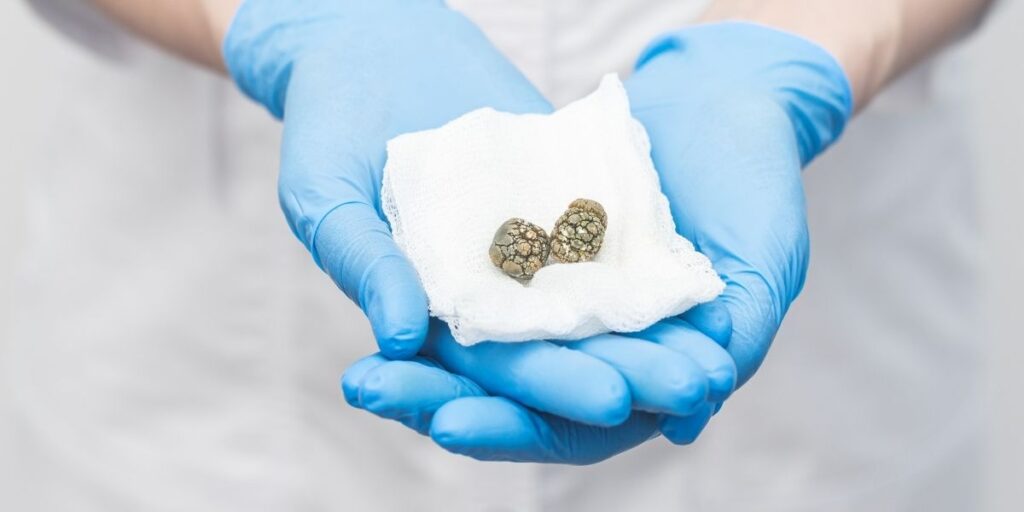
The gallbladder is a pear-shaped sac located under the liver. It stores and concentrates bile produced by the liver. Bile is a greenish-brown alkaline fluid containing waste products, cholesterol, and bile salts. Bile itself is not a digestive enzyme, but bile salts break down large fat droplets, functioning similarly to digestion. The chemical composition of bile is usually sufficient to dissolve the cholesterol coming from the liver; however, sometimes excess cholesterol from the liver can crystallize over time, leading to the formation of gallstones.
Gallstones usually occur around the age of 40 and are more common in women and overweight individuals, affecting approximately 1 in 10 people. They are generally harmless and do not require emergency surgery; however, gallstones that block the bile ducts can cause severe infections in the bile ducts, pancreas, or liver, which can be life-threatening. Therefore, they need to be monitored.
What are the types of gallstones?
Gallstones are generally classified into two groups based on their composition: cholesterol stones and pigment stones. When examining the structure of gallstones, in addition to the main components—cholesterol, bile pigment, and calcium—small amounts of iron, phosphorus, carbohydrates, cellular debris, and mucus can also be found.
What are the symptoms of gallstones?
The vast majority of gallstones remain asymptomatic throughout life and are discovered incidentally. However, in about 12% of patients, symptoms may occur due to insufficient bilirubin excretion. These patients may experience upper abdominal pain, stabbing pain radiating to the back and right shoulder, nausea, vomiting, fever, chills, jaundice, abdominal bloating, indigestion after consuming fatty foods, belching, and gas.
How are gallstones diagnosed?
For diagnosis, a detailed medical history and physical examination are required. This is followed by complete blood count, liver function tests, bilirubin, amylase, urinalysis, and abdominal ultrasonography. If symptoms are present but no issues are detected on ultrasound, an oral cholecystography (including scintigraphy of the gallbladder and bile ducts) is performed. If necessary, computed tomography (CT), magnetic resonance imaging (MRI), endoscopic retrograde cholangiopancreatography (ERCP), and percutaneous transhepatic cholangiography (PTC) can also be used for diagnostic purposes.
How are gallstones diagnosed?
Treatment of gallstones in the gallbladder is divided into surgical and non-surgical methods. Gallstones that cause very severe symptoms are treated surgically, with the gallbladder being removed.
Nowadays, laparoscopic gallbladder surgery is preferred over open surgery.
Non-surgical treatments are used for high-risk patients who cannot undergo surgery or for those who refuse surgery. These treatments involve the use of litholytic agents (medications that dissolve stones) and are only effective if the gallbladder is still functional and the gallstone is a pure cholesterol stone. The treatment is not permanent, and stones may re-form in about half of the patients afterward.
Should gallstones be removed as soon as they are detected?
Not every gallstone requires surgery. If the gallstone does not cause symptoms such as upper abdominal pain, stabbing pain radiating to the back and right shoulder, nausea, vomiting, fever, chills, jaundice, abdominal bloating, indigestion after fatty foods, belching, or gas, annual monitoring is recommended.
Can a person live without a gallbladder?
Since the entire gallbladder is removed during gallstone surgery, a person can easily continue life without a gallbladder.
The gallbladder acts as a storage organ in the body. After surgery, since the storage function is lost, the body adjusts the amount of bile secreted by the liver on its own. Within 7–10 days, patients begin to adapt to their new digestive system.